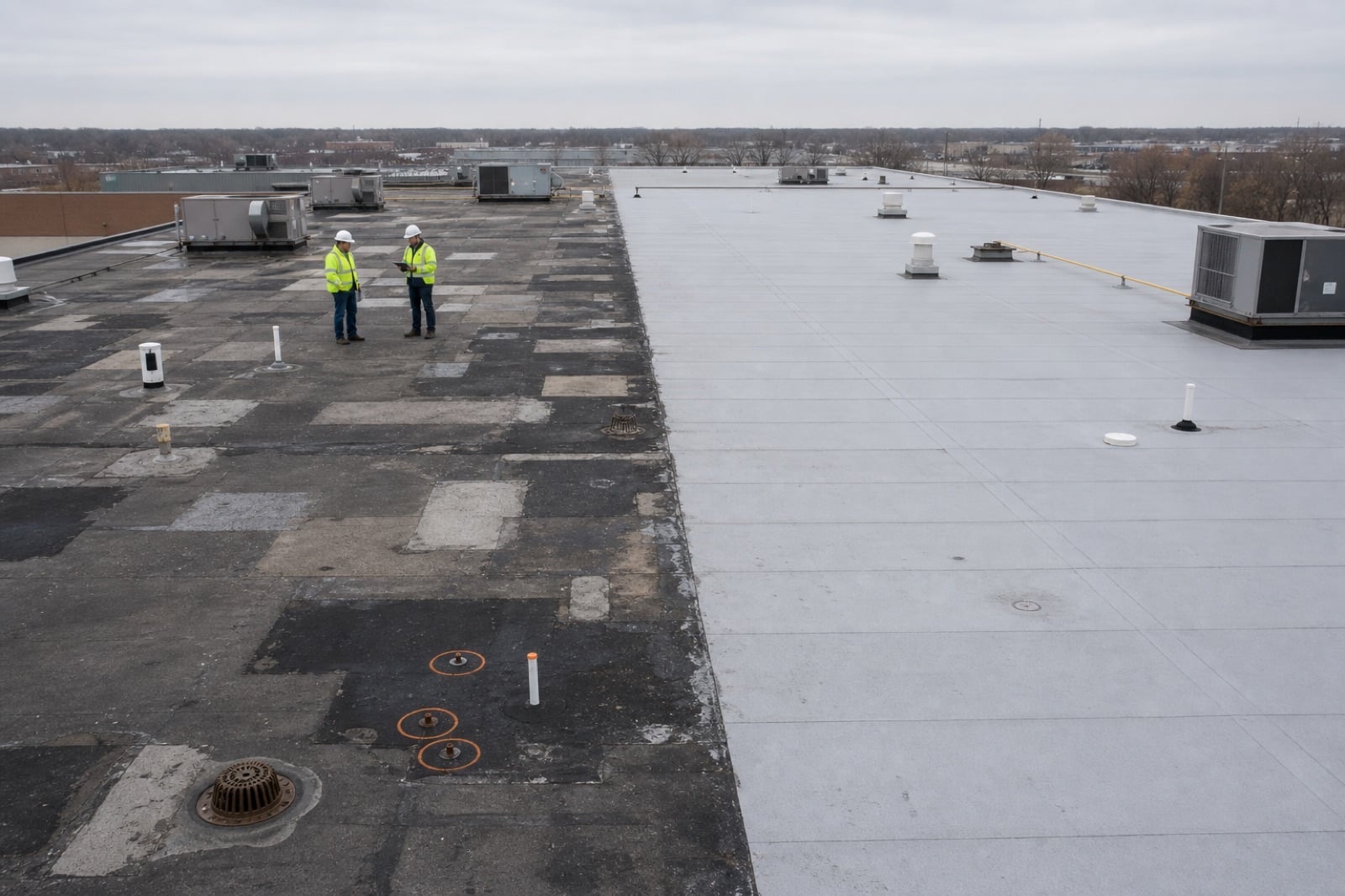
Commercial roof repair vs. replacement: decide with condition, not frustration.
One more leak does not automatically mean replacement, and one successful patch does not prove the roof still has a sound capital future. The decision should compare the extent and cause of failure, how much dry and serviceable assembly remains, the risk to operations, and what each option can realistically restore.
Editorial and technical review: Meadow Services operating team · August 17, 2026
Commercial properties onlyBuilt around facility responsibility
One accountable relationshipFrom request through completion
Scope before assumptionsProperty conditions and constraints matter
Evidence for the repair-or-replace decision
01Roof age, assembly, deck, drainage, code, warranty, and ownership history
02Leak frequency, repair locations, repeated causes, and operational consequences
03Moisture extent, insulation performance, trapped water, and concealed deterioration
04Condition of membrane, seams, flashings, edges, penetrations, curbs, and transitions
05Upcoming HVAC or rooftop work, tenant needs, solar, and other capital plans
06Repair life, replacement timing, disruption, warranty outcome, and total risk
How to use this planning guidance.
Ask what a repair restores
A localized repair can be strong value when the surrounding assembly is dry and serviceable and the cause is defined. Its expected benefit is different when failures are widespread, moisture is extensive, or details are repeatedly breaking down.
Compare decisions over the same time horizon
Repair cost today and replacement cost today are not directly comparable unless the analysis includes expected remaining life, future repairs, interior risk, disruption, energy or insulation effects, and the owner's holding period.
Use investigation proportionate to the decision
Records and visual review may support a small repair. A major capital decision may justify core cuts, moisture survey, deck investigation, drainage review, professional input, and defined alternatives.
EDITORIAL METHOD
Planning guidance, not a substitute for the project record.
This guide helps a commercial property team organize a request and the next decision. Actual site conditions, adopted codes, manufacturer instructions, permits, contracts, qualified assessments, and approved project documents control the work.
BUYER QUESTIONS
Questions to resolve before the next decision.
How many roof repairs are too many?+
There is no universal count. Look at recurrence, total annual spend, extent of wet or deteriorated assembly, operational damage, whether causes are localized, and how much reliable service life repairs are actually restoring.
Can only part of a commercial roof be replaced?+
Sometimes. Separate roof areas, additions, drainage basins, or construction joints may support phased replacement, but tie-ins, moisture boundaries, warranty, code, drainage, and future phases must be planned.
What makes commercial roof replacement urgent?+
Examples include unsafe deck conditions, uncontrolled widespread leakage, extensive moisture, repeated failure with high operational consequence, loss of weather protection, or conditions that cannot be dependably stabilized. The actual urgency requires site-specific evaluation.
Send the roof age and type, area, leak and repair history, warranty, photos, known moisture or deck information, operational impact, upcoming rooftop projects, and desired ownership horizon.