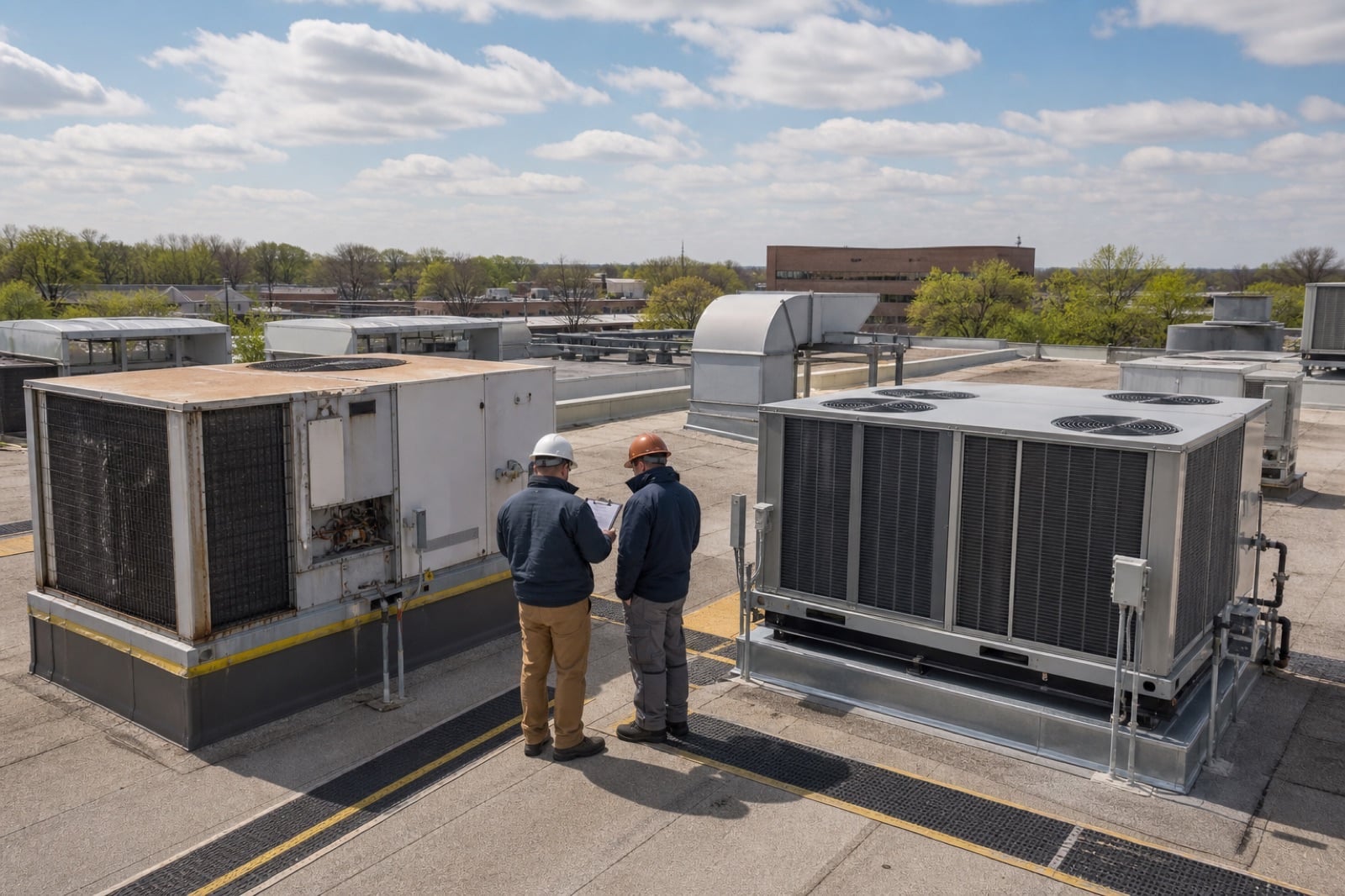
Commercial HVAC repair vs. replacement: compare reliability, access, and operating risk.
A failed component can justify repair even on older equipment; repeated failures can justify replacement before the unit is completely unusable. The right choice depends on verified condition, what the system serves, parts and refrigerant realities, capacity and controls, seasonal risk, and the full building work required to install a replacement.
Editorial and technical review: Meadow Services operating team · August 17, 2026
06Season, lead time, redundancy, temporary conditions, shutdown, startup, and capital plan
How to use this planning guidance.
Separate one failure from system trajectory
A discrete repair may restore dependable service. Repeated compressor, coil, heat-exchanger, controls, leak, or electrical problems can show a different reliability pattern that should be compared with replacement timing.
Make the decision before the worst operating window
A planned replacement can preserve choice in equipment, sequence, and outage. An emergency failure during extreme weather may narrow options and increase the cost of temporary conditions or disruption.
EDITORIAL METHOD
Planning guidance, not a substitute for the project record.
This guide helps a commercial property team organize a request and the next decision. Actual site conditions, adopted codes, manufacturer instructions, permits, contracts, qualified assessments, and approved project documents control the work.
Does equipment age alone determine whether to replace commercial HVAC?+
No. Age is one input alongside condition, failure cause, service history, parts, refrigerant, performance, criticality, efficiency, controls, building plans, and the expected reliability of a repair.
Why does an HVAC replacement involve more than the mechanical unit?+
Commercial equipment interfaces with structure, roof, ductwork, piping, drainage, power, controls, fire and life-safety systems, access, lifting, permits, startup, and occupied operations.
Can replacement be planned before the current unit fails?+
Yes. Condition and risk planning can identify equipment to monitor, repair, budget, engineer, procure, or replace in a controlled season before an unplanned outage forces the decision.
Send the equipment make, model and age, nameplate photos, service history, current failure, areas served, controls, known comfort or capacity issues, roof or access constraints, and acceptable downtime.